
"Innocent Men Set Free" Published by Matt Daher & Kristen Mason
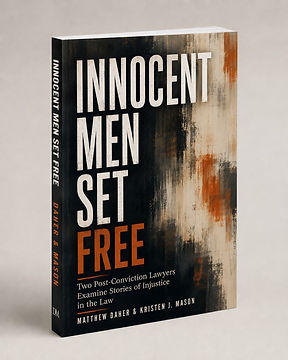
Two post-conviction attorneys have co-authored a new book about how the American criminal justice system convicts innocent people, and how hard it fights to keep them inside once it has. Innocent Men Set Free: Two Post-Conviction Lawyers Examine Stories of Injustice in the Law, written by Matt Daher and Kristen Mason, is available now in paperback (ISBN 979-8-199015-19-6, Amazon link).
The book tells four true stories in full: a father in Texas, a teenager in East Los Angeles, a commuter in Brooklyn, and a former Coast Guard rescuer in Florida. Different decades, different crimes, the same patterns running underneath each one.
“Four innocent men. Four states. Decades stolen for crimes they never committed.”
Four Cases, One Set of Patterns
The four men in this book have almost nothing in common. They differ in race, age, education, criminal history, and the kind of crime each was accused of. What put them in prison does not differ at all. Mistaken eyewitnesses who were certain. Coercive plea deals. Court-appointed lawyers who declined to investigate. Forensic testimony, including early DNA evidence, that was overstated to juries who had no way to push back.
A San Antonio father who could barely read or write was pressed into a no-contest plea by his own attorney and lost more than five years before his accusers admitted the abuse never happened. A 19-year-old in East Los Angeles served 29 years for a murder he was not present for, freed only after the sole eyewitness recanted. A Brooklyn commuter and a Florida rescue swimmer each lost decades to convictions built on the same kinds of mistakes. The details change from state to state. The machinery does not.
“Most innocent people in prison never will be. This book is about closing that gap.”
What Actually Set These Men Free
One of the book’s hardest lessons is that the system rarely corrects itself. Direct appeals were affirmed. Post-conviction motions were denied, sometimes for years. What finally undid these convictions came from the outside: a minister with a typewriter who wrote the letters an illiterate man could not, a woman from a man’s past who paid investigators out of her own savings, a law-school investigator who found a recanting witness on Facebook, and an attorney who heard an old case described on a podcast and decided to look into it.
That is why the book is written for the people who can actually make that difference. Alongside the four stories, the authors lay out, in plain language, the post-conviction tools that families can use to fight a wrongful conviction, from direct appeal through state and federal habeas corpus, and the reforms that would have changed these four outcomes.
Who Should Read It
Innocent Men Set Free is written for incarcerated people, for the families fighting for them from the outside, and for anyone who wants an honest account of how wrongful convictions happen and how, on rare occasions, they are undone. It is drawn entirely from the public record: trial transcripts, appellate opinions, district attorney press releases, conviction-review reports, the National Registry of Exonerations, and local news coverage.
About the Authors
Matt Daher is the lead attorney for firm's Texas practice and has more than sixteen years of experience litigating matters in state and federal courts. His practice focuses on direct appeals, Article 11.07 writs of habeas corpus, and federal habeas petitions. He is also the author of Justice Lost, Justice Gained: How Five Texas Inmates Won Their 11.07 Appeals and Inequality in the Texas Criminal Justice System.
Kristen J. Mason heads the California practice and handles direct appeals, habeas corpus petitions, and post-conviction relief in state and federal court. She has been recognized as a Super Lawyers Rising Star from 2024 through 2026, and she is also the author of Unlocked: How California’s New Laws Are Giving Inmates a Second Chance.
Both authors practice at Criminal Appeals Advocates P.C.
Innocent Men Set Free is available now in paperback. To have a consultation with one of the authors, contact the law firm at the phone number listed on the contact page.

